

Community Provision
Providing support to women in safe environments and promoting peer support.
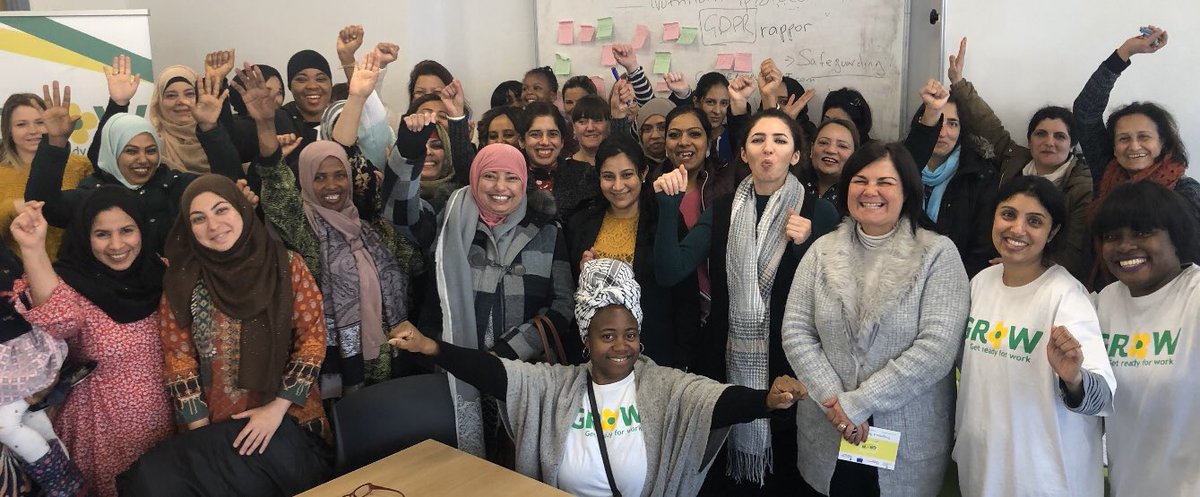
A key element of our work is bringing support to where women live in environments where they feel safe. We deliver within settings such as Family Hubs, community spaces, women’s centres and at local housing associations. Our advisers are largely drawn from the communities which they serve, with over twelve community languages spoken. Many of our advisers have completed one of our programmes and know first-hand what support has helped them to progress. Our programmes include in person delivery where a community of women work to support each other. This is backed up with a WhatsApp Group of their cohort as well as access to our App where they can hear about what is happening in their community, training and job opportunities as well as case studies to inspire their own next steps.
It is positive that the new Government proposes to support local devolution of employment support. It will be important within these plans to include smaller specialist providers such as ours. Currently, whilst there is some subcontracting to smaller providers, these can be short term and make it harder for providers like us to remain sustainable. Their needs to be sustained funding for local specialist provision including delivery by smaller specialist providers who have experience of offering tailored support to mothers within their communities as well as engagement with those who are economically inactive and those who face multiple disadvantages.

Support for Lead Carers to Upskill including Opening up the Free Childcare Offer to those Undertaking Training
Introducing Lead Carer Advisers to better meet the needs of lead carers and ensure they receive specialist assistance and flexibility.
Many of the women that we work with want to improve their skills in order to improve their job prospects. We are currently funded by the GLA on a project particularly focused on improving maths and work specific skills and we have worked with skills providers to better design provision particularly for mothers. Lead carers (the main carer in a couple (mostly mothers) and single parents (9:10 are women) want to train or retrain to improve their work prospects but have not been encouraged to do so by the jobcentre regime. This is illustrated by the mothers on our programmes who have started teaching assistant courses and have a plan to do longer term courses and volunteering only to be told by their work coach that they must move into any job as quickly as possible.
It is constructive that the new Government will be combining the jobcentre and careers service. A vital part of joining this service will be the recognition of the need for some jobseekers to upskill. It is reasonable that whilst someone is on a course of study that is focused on improving their work prospects that they are left alone to concentrate on their studies and to have their job seeking is turned off for a period of time. A further stumbling block for lead carers face is that they do not have access to free expanded childcare offer. The childcare offer is linked to lead carers working and is not open to those who are training. This needs to change. The free childcare offer should be open to lead carers who are upskilling to improve their job prospects.
Jobcentre Plus Ethos and Specialist Provision
Meeting the unique needs of lead carers and ensuring realistic claimant commitments that respect their rights and responsibilities.
We work constructively with Jobcentre Plus, both with work coaches and managers. We have held programme sessions at Jobcentre Plus and have received referrals through them as well as being funded by the DWP. But a lack of specialist provision for mothers at Jobcentre Plus is a barrier to both tailored provision to this group as well as consistent referral onto specialist provision such as ours. In the past Lone Parent Advisers were a valuable resource to understanding the needs of lone parents to work and care and could provide support around flexible working and children. They could also communicate the flexibilities that were on offer to parents and referral to specialist external provision. In recent times generalist work coaches have not provided this nuanced provision. There should be the introduction of Lead Carer (or Parent Advisers) at Jobcentres or at the new iteration of the local employment service. This will help ensure that lead carers get the specialist support that they need as well as a conduit for referral onto outside specialist provision.
We recognise that currently work coaches have a tough job in policing benefits and providing employability support. It is a welcome change that the new Government wants to change the emphasis for employability support away from the policing of benefits and to a more holistic work and career service. It will be important to acknowledge the particular needs of lead carers, in this changed service. As well as the communicating the responsibilities of job seekers it is important to communicate how the back to work regime is designed for lead carers including the flexibilities. We know from our work that this can mean that lead carers having unrealistic requirements in their claimant commitment. No claimant commitment (or contract) should be agreed without there being evidence that a job seeker is clear about their rights and responsibilities. Jobseekers should also be able to challenge their action plan if they do not think it is reasonable.
 Belina GRoW CIC